There comes a moment in every civilization when it must pause, look at the screens flickering in every palm and every corner, and ask itself: what are we teaching our children to see?
In contemporary India, the proliferation of cinematic and digital content has fundamentally transformed the developmental landscape for children and adolescents. Cinema has transcended its traditional role as mere entertainment, emerging as one of the most influential vectors of behavioral and cultural transmission in modern society. Despite this paradigm shift, India’s formal education system has yet to adopt a comprehensive framework that addresses this pedagogical necessity. Recognizing this critical gap, Filmmaker Avinash Tripathi, with nearly a decade of experience in film education at a leading Indian university, has emerged at the forefront of educational advocacy—championing the integration of film and media literacy into mainstream curricula as an essential academic reform rather than a mere aesthetic or artistic preference.
This is the gap Filmmaker Avinash Tripathi has been pointing at, not with a raised finger of accusation, but with the steady hand of someone who understands that cinema’s power demands cinema’s wisdom.
Filmmaker Avinash Tripathi’s Mission Since 2016: A Sustained Advocacy That Refuses to Fade
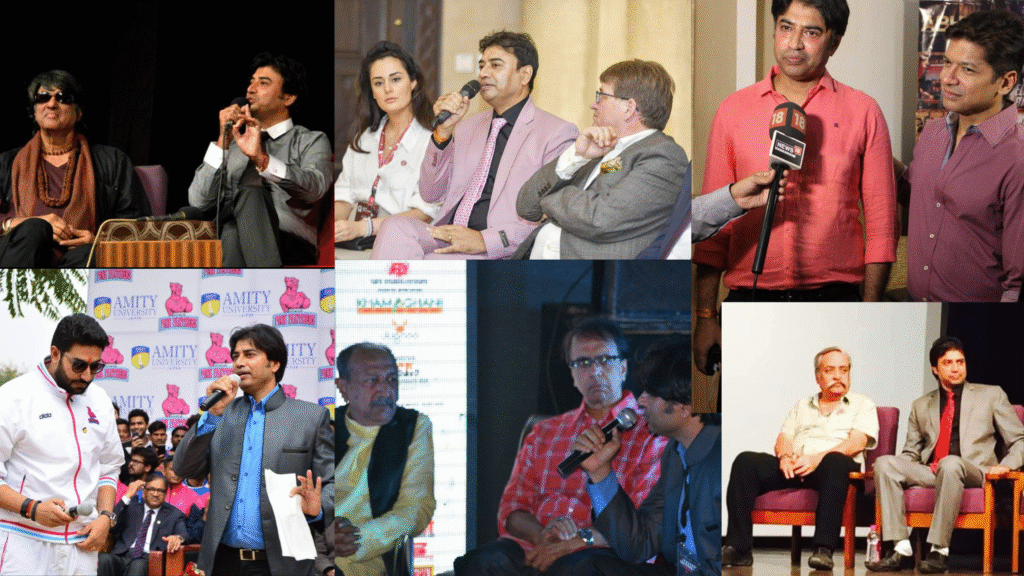
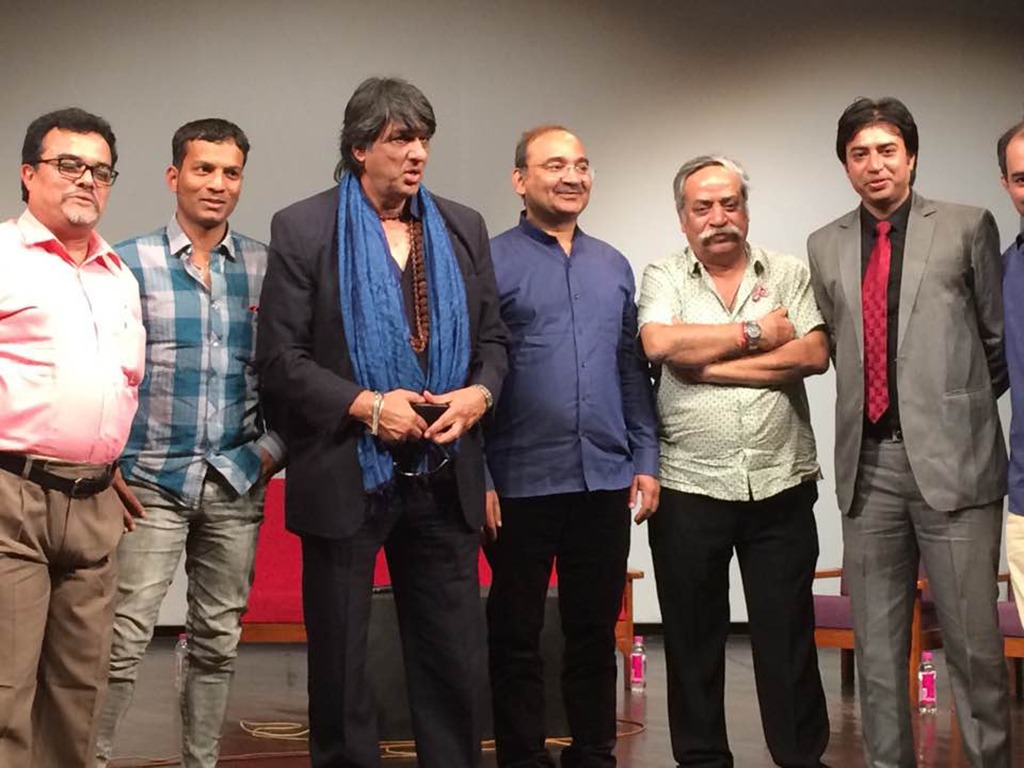
In November 2016, the Children’s Film Society of India organized the Children’s Film Festival in Jaipur, where Filmmaker Avinash Tripathi participated in a panel discussion alongside leading Bollywood personalities. During this session, Avinash Tripathi strongly raised the need to integrate film and media education into India’s education system. His perspective received collective agreement from the panel, underscoring a shared belief that future generations require structured guidance to understand cinema responsibly and critically. Various English and Hindi top media covered the news in detail like Times of India, The Indian Express, IndiaToday etc.
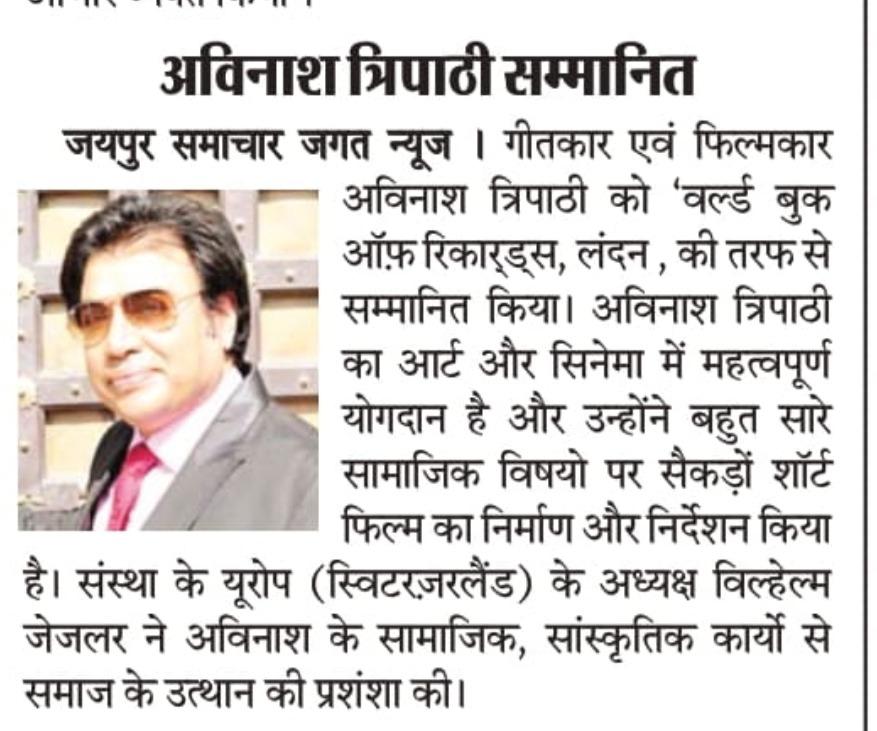
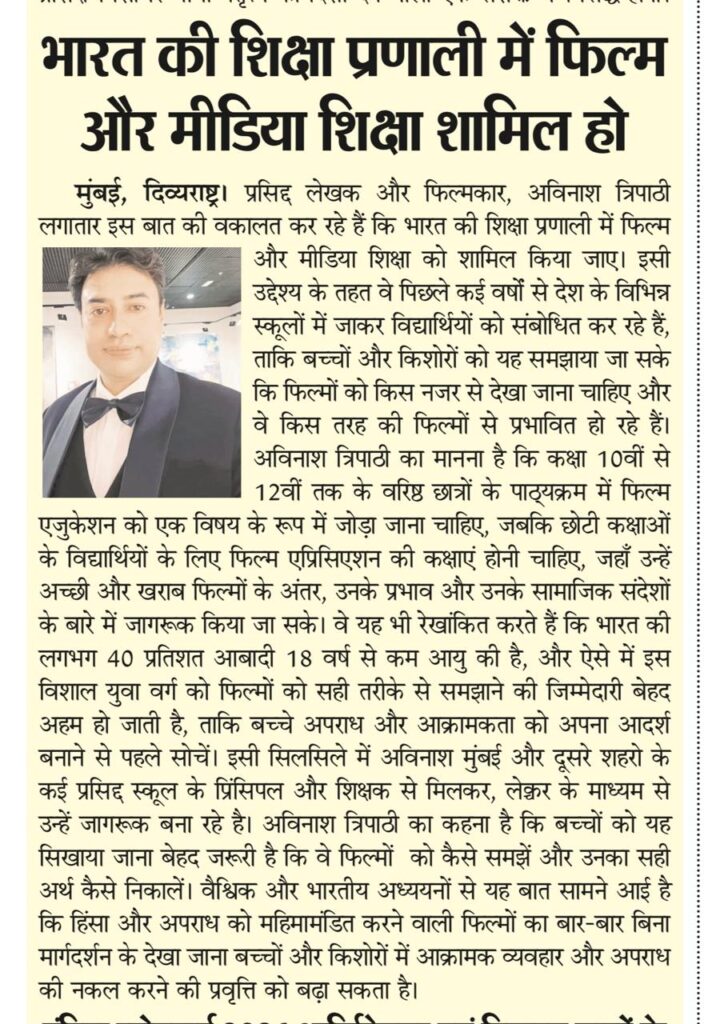
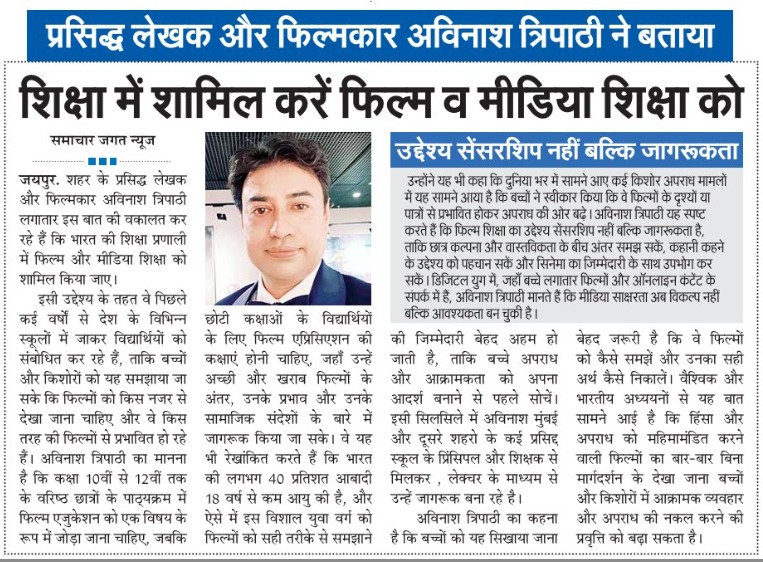
On 9 January 2026, multiple media platforms such as Samachar Jagat, Mumbai Divyrasthra, once again highlighted the urgency of this issue, repeatedly raising critical questions among policymakers regarding the necessity of integrating film and media education into the formal education system. (Also read the full article about Avinash Tripathi’s Digital media coverage- CLICK HERE )
Since then, Avinash Tripathi has been taking various seminars, special sesstions at various schools and universities across the nation, not as a filmmaker promoting films, but as an educator advocating for awareness.
This hasn’t been a one-time campaign, a flash of concern that fades with the changing news cycle. Filmmaker Avinash Tripathi has been conducting lectures, panel discussions, and awareness sessions year after year, returning to the same core concern with the kind of dedication that only comes from genuine alarm: our children are consuming cinema continuously, voraciously, but they’re doing it without a map, without a compass, without anyone teaching them how to navigate what they’re seeing.
His work takes the form of interactive discussions where he doesn’t just speak at students and teachers—he speaks with them, raising questions that linger long after the lecture ends. Questions about cinema’s influence on young minds. Questions about the responsibility educational institutions carry when every teenager has a screen in their pocket and stories flooding through it every waking hour.
Why Film and Media Education Is Essential for Students: Learning to Watch, Not What to Watch
Avinash Tripathi makes a distinction that cuts through the noise of moral panic and censorship debates. He’s not interested in telling students what films they should or shouldn’t watch. His proposal is simpler and more profound: teach them how to watch.
Understanding cinema, he argues, deserves the same academic seriousness we bring to literature, to history, to the study of human nature itself. Because cinema is the literature of our time, the history being written in real-time, the mirror reflecting and shaping what it means to be human in the twenty-first century.
His vision is structured and clear:
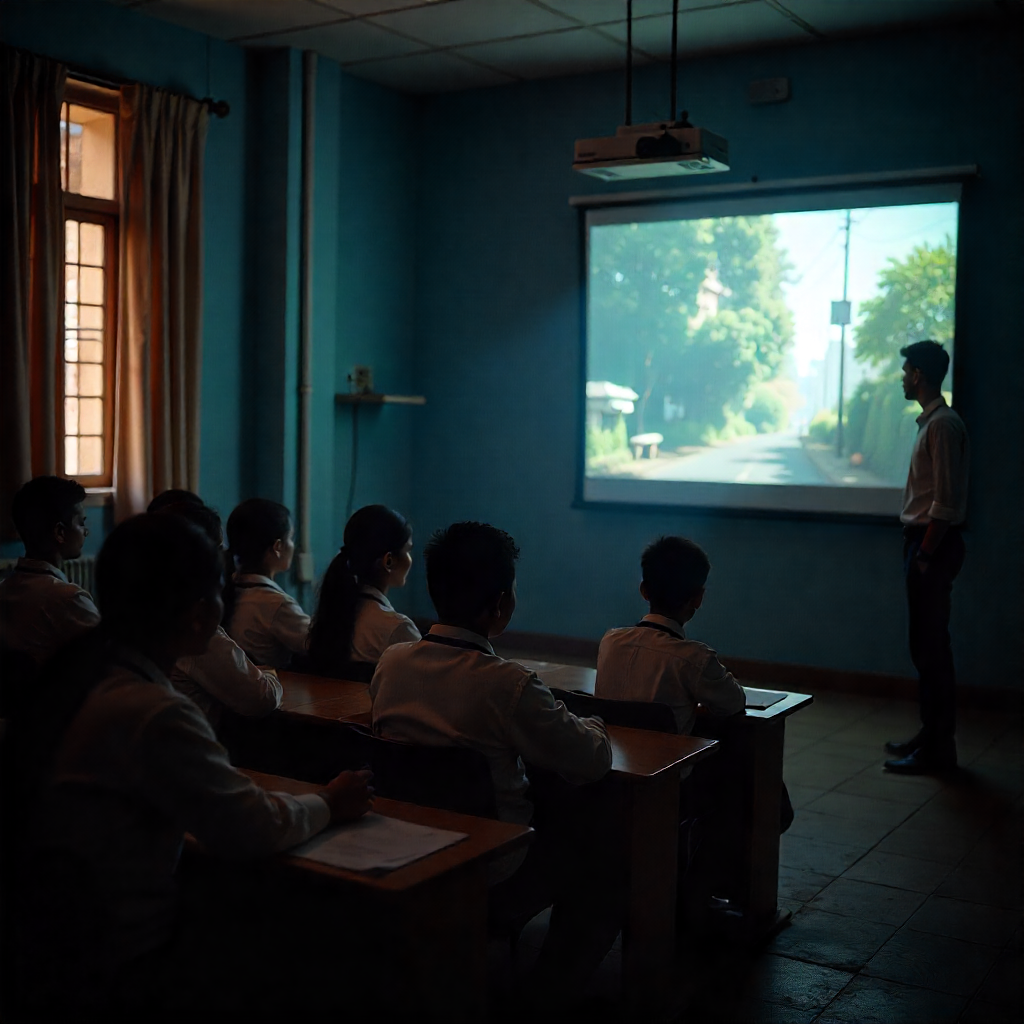
Classes 10 to 12 should have film education as a formal subject, with the weight and curriculum of any other academic discipline.
Younger classes should be introduced to film appreciation, where students begin learning:
- The difference between good cinema and harmful cinema
- How visuals and narratives work on the mind and emotions
- The social messages embedded in stories, whether the filmmakers intended them or not
- The gap between what’s shown on screen and what exists in reality
This isn’t about creating film critics in every classroom. It’s about nurturing critical thinking, about ensuring that students develop the ability to pause, reflect, and question rather than simply consume and absorb.
The Demographic Reality India Cannot Afford to Ignore
Filmmaker Avinash Tripathi keeps returning to a number that should make every educator, every parent, every policymaker sit up: nearly 40 percent of India’s population is below the age of 18.
Let that settle in your mind for a moment. Four out of every ten people in this country are at the most impressionable stage of their lives, their values still forming, their understanding of right and wrong still taking shape. And they’re all watching. They’re watching films, web series, short videos, reels—stories that glorify, stories that condemn, stories that blur the line between hero and villain until the distinction becomes meaningless.
In such a scenario, the responsibility to guide this massive young population isn’t optional. It’s existential. Without guidance, without education in media literacy, there’s a genuine risk that children may begin to admire crime before they understand consequence, adopt aggression before they develop empathy, embrace distorted heroism before they learn what genuine courage looks like.
Film and media education becomes, in this context, more than curriculum. It becomes a protective intellectual framework, a set of tools that enables students to pause before believing, to reflect before imitating, to question before adopting what flickers across their screens as truth.
The Link Between Unguided Cinema and Aggressive Behaviour: Research That Cannot Be Dismissed
Avinash Tripathi doesn’t base his advocacy on gut feeling or moral righteousness. He consistently references global and Indian studies that reveal a correlation too strong to ignore: repeated exposure to films glorifying violence or crime correlates with the development of aggressive behaviour among children and teenagers.
The research shows patterns that would be alarming even if they appeared occasionally. But they don’t appear occasionally—they appear consistently:
- Repeated, unguided viewing of violent content normalizes aggression, turns brutality into background noise
- Adolescents imitate cinematic characters and scenes, especially when those characters are presented as powerful, respected, successful
- Crime begins to appear aspirational when consequences are never discussed, when the camera lingers on style and swagger but cuts away before showing the broken families and destroyed lives
Real-world juvenile crime cases worldwide have teenagers openly acknowledging the films, the characters, the specific scenes that influenced their actions. These aren’t theoretical concerns. These are courtroom testimonies.
The urgency of structured Film education isn’t about protecting children from cinema. It’s about protecting them from consuming cinema without understanding it, from letting fictional narratives write the scripts of their real lives.
Film Education Is Awareness, Not Censorship: A Critical Distinction
Avinash Tripathi makes this clarification in almost every discussion, and it’s worth emphasizing here because this is where misunderstanding breeds resistance: film and media education is not censorship.
Its purpose isn’t to restrict creativity, to ban films, to control what content gets made or consumed. In a democratic and creative society like India, such restriction would be both impossible and undesirable.
Instead, film education aims to:
- Help students differentiate between imagination and reality, between what’s permissible in fiction and what’s acceptable in life
- Understand storytelling intent and narrative design—to recognize when they’re being entertained, when they’re being manipulated, when they’re being sold an idea
- Recognize emotional manipulation through visuals, through music, through editing techniques that make the heart race and the mind shut down
- Consume cinema responsibly and consciously, as active interpreters rather than passive receivers
This distinction matters. It’s the difference between living in a society that fears art and living in a society that understands it.
The Role of Schools, Teachers, and Principals: Facilitators, Not Filmmakers
As part of his sustained mission, Filmmaker Avinash Tripathi has been actively engaging with school principals and teachers, conducting lectures and discussions to sensitize them about the importance of media literacy. And he makes a point that removes one of the biggest barriers to implementation:
Teachers don’t need to be filmmakers to teach film appreciation.
They don’t need to understand camera angles and three-act structure and mise-en-scène. What they need is the right framework, the right questions to ask. With that, educators can guide students to:
- Ask the right questions when watching films
- Interpret visual narratives instead of just receiving them
- Discuss social and moral consequences instead of just reacting to action and emotion
Schools, in this vision, become facilitators of awareness rather than enforcers of restriction. They become places where students learn to think about what they watch, not places where someone decides what they’re allowed to see.
Media Literacy in the Digital Age: No Longer Optional, Now Essential
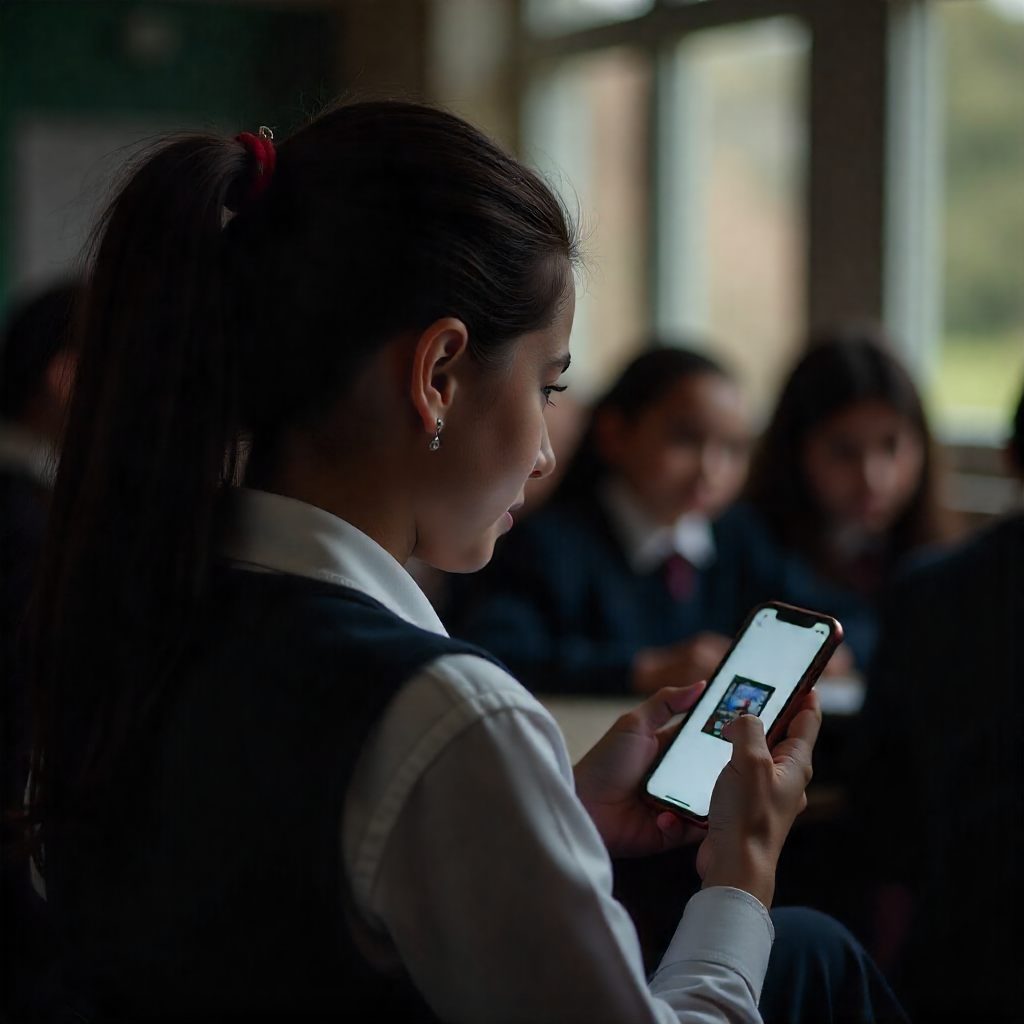
The world has shifted beneath our feet. In today’s digital environment, children are constantly exposed to films, OTT platforms, short videos, social media content that ranges from educational to exploitative, from inspiring to insidious. According to Avinash Tripathi, media literacy has crossed the threshold from optional skill to essential survival tool.
Consider what happens without media education:
- Children remain vulnerable to misinformation, unable to distinguish fact from sophisticated fiction
- Emotional manipulation goes unchecked, with content designed to trigger outrage, fear, desire without students recognizing the strings being pulled
- Aggressive or criminal behaviour may appear justified through clever storytelling, with glamour coating violence and success masking immorality
Now consider what happens with media education:
- Students develop analytical skills that serve them far beyond cinema halls and streaming platforms
- Emotional intelligence improves as they learn to recognize how stories work on emotions and why
- Social responsibility strengthens because they understand that every story they consume, every narrative they internalize, shapes the person they become
The choice isn’t between education and no education. The choice is between intentional education and accidental education, between giving students tools or leaving them to figure it out alone while algorithms and market forces shape what they see.
Growing Recognition of Avinash Tripathi’s Advocacy: From Individual Voice to National Discourse
The sustained nature of Filmmaker Avinash Tripathi’s work has begun receiving recognition through print and digital media coverage, signaling that this advocacy is no longer one man’s concern but an emerging educational discourse.
This recognition matters not because it validates Avinash Tripathi personally, but because it indicates that the conversation about film and media education in school syllabus is gaining the seriousness it deserves. More educators are listening. More institutions are asking questions. More parents are realizing that the screens their children watch deserve the same educational attention as the books they read.
The demand for film and media education is shifting from individual opinion to collective necessity, from filmmaker’s perspective to educational imperative.
The question isn’t whether cinema influences young minds. Research confirms it does. The question isn’t whether students are consuming enormous amounts of visual content. Screens everywhere confirm they are.
The only question that remains is this: will we continue to let that consumption happen without guidance, without education, without the tools that would help students navigate what they see?
Or will we finally acknowledge that in contemporary India, where films and digital content dominate the cultural landscape, film and media education in school syllabus isn’t an optional extra—it’s an essential foundation for raising generations who can think critically, watch consciously, and distinguish between the stories that elevate humanity and the ones that diminish it?
Avinash Tripathi has been advocating for this since 2016. The real question is how much longer we’ll make him wait ?
We welcome perspectives and invite comments and reflections on this issue.